

Himachal Pradesh, an Indian state, recognized for its stunning landscape and Hill stations. Positioned in the Western Himalayas, it is one of the eleven mountain states of India. Most of the state lies on the foothills of the Dhauladhar Range. At 6,816 m, Reo Purgyil is the highest mountain peak in the state of Himachal Pradesh.

The foothills of the modern state of Himachal Pradesh were populated by people from the Indus valley civilisation. The Kols or Mundas are supposed to be the original migrants to the hills of present-day Himachal Pradesh followed by the Bhotas and Kiratas.
Himachal Pradesh has long Political as well as cultural History. State has compromises of different dance forms, songs, languages, food and other things.

Diverse categories of dance forms in Himachal Pradesh are
1 Nati
2 Mala (Garland)
3 Demon (Rakshasa)
4 Dalshone and Cholamba
5 Shand and Shabu
6 Tribal dances
NATI

Nati is the well-known dance of Himachal Pradesh. It is listed in the Guinness world record book as the largest folk dance. It largely originated from Kullu district and became popular across the state. Numerous sorts of Nati dances are popular in Himachal Pradesh including Kullvi Nati, Mahasuvi Nati, Sirmauri Nati, Kinnauri Nati and Lahauli Nati. The Kinnauri Nati dance is mime-like and comprises unenergetic categorizations. Important among the dances of Nati is ‘Losar shone chuksom’. The name from Losai, or the New Year. Events such as sowing the crop and reaping it are included in it.
The Nati Dance in the second week of January 2016 was recorded in the Guinness Book of World Records as the largest folk dance in the world. Nati entered in the book as the largest folk dance in terms of participants’ number. Total 9892 women participated in this folk dance in their traditional colourful Kullvi dress on 26 October 2015 during International Dussehra festival which is a centuries-old festival and celebrations begin on Vijaya Dashami, the day when the festivities end in rest of the country.
The Himachal Pradesh is the house of Nati dance.
MALA

The Mala dance another dance form of Himachal Pradesh. Performers dress in traditional finery, weave their arms together to form a kind of a crisscross design in order to appear like beads in a woven garland. They drink chhang (a rice brew) before this dance.
Demon
Demon dance from Kinnaur and close areas are indicative of the historic period. The dance is performed with demon masks. It represents the attack of the demons on the crops and their ritual pursuing away by the forces of good.
cholamba
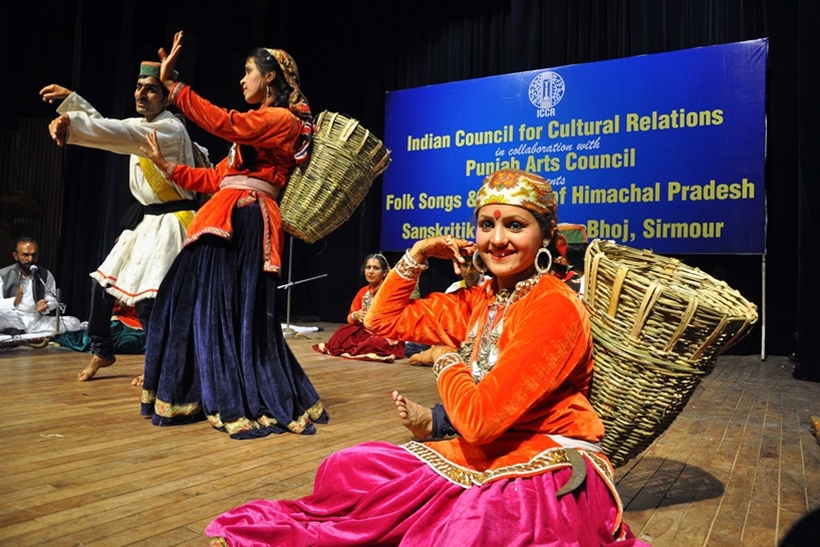
it is similar to the Punjabi dance Bhangra. These dance forms are generally organised in areas having dense population. This dace is performed During their local festivals like Chaitol and Bishu, Men and women hold hands and dance together. Their leader is known as Ghure.
The Dalshone and Cholamba dance forms belong to the Ropa valley. The pattern formed by the dancers seems to resemble coiled serpents. Cholamba is generally performed when a tiger is killed. The dead animal’s skin is bloated and a gold ornament is put in his nose. The remains of the corpse are then switched and people dance around it.
Shand and Shabu
These are the most popular dances of the Lahaul valley and are generally danced at Buddhist Gompas in the memory of the Buddha.
Shan means a prayer for Buddha. Dances to these prayers are termed Shan dances. This tribal dance is performed after the completion of the harvest. Instruments contain drums, shehnai and a stringed instrument like a violin.
A similar dance form known as Shabbo is also performed at festivals. It represents the principles and regime of the tribal people.
Tribal dances
The Keekali dance form is usually for young girls. The girls hold each other’s hand crosswise and rotate swiftly on their toes.
The dance forms of the trans-Himalayan region differ in content and music.
One masked dance form features an important event in the history of Himalayan Buddhism when Lamas effectively carried out a plan of executing King Langdarma. A special event for masked dances is performed in celebration of birth of Padma Sambhava, who carried the message of Buddhism to Tibet.
The state is full of History and Culture which is still preserved.

Information Source : Wikipedia
BY ARUSHI SHARMA
 THOUGHT-SO-RAMA
Proud to be Himachali.
LikeLike